
LED vs LCD Displays: What’s the Difference and How to Choose?
When comparing modern display technologies, one question appears repeatedly: LED display or LCD display—which one is better?
The answer depends on the application. LCD screens dominate televisions, monitors, and small-format displays, while LED displays have become the preferred solution for large-format digital signage, retail media, event stages, architectural displays, and transparent display installations.
To understand why, we first need to understand how these two technologies work.
What Is an LCD Display?
The name itself reveals its nature. LCD stands for Liquid Crystal Display, a technology built around a unique state of matter that exists between a solid and a liquid. The most remarkable property of liquid crystal materials is that their molecules naturally align in specific directions. When voltage is applied, the alignment changes in a predictable and controllable way. This ability to alter optical properties under electrical control makes liquid crystal an exceptionally effective display medium.
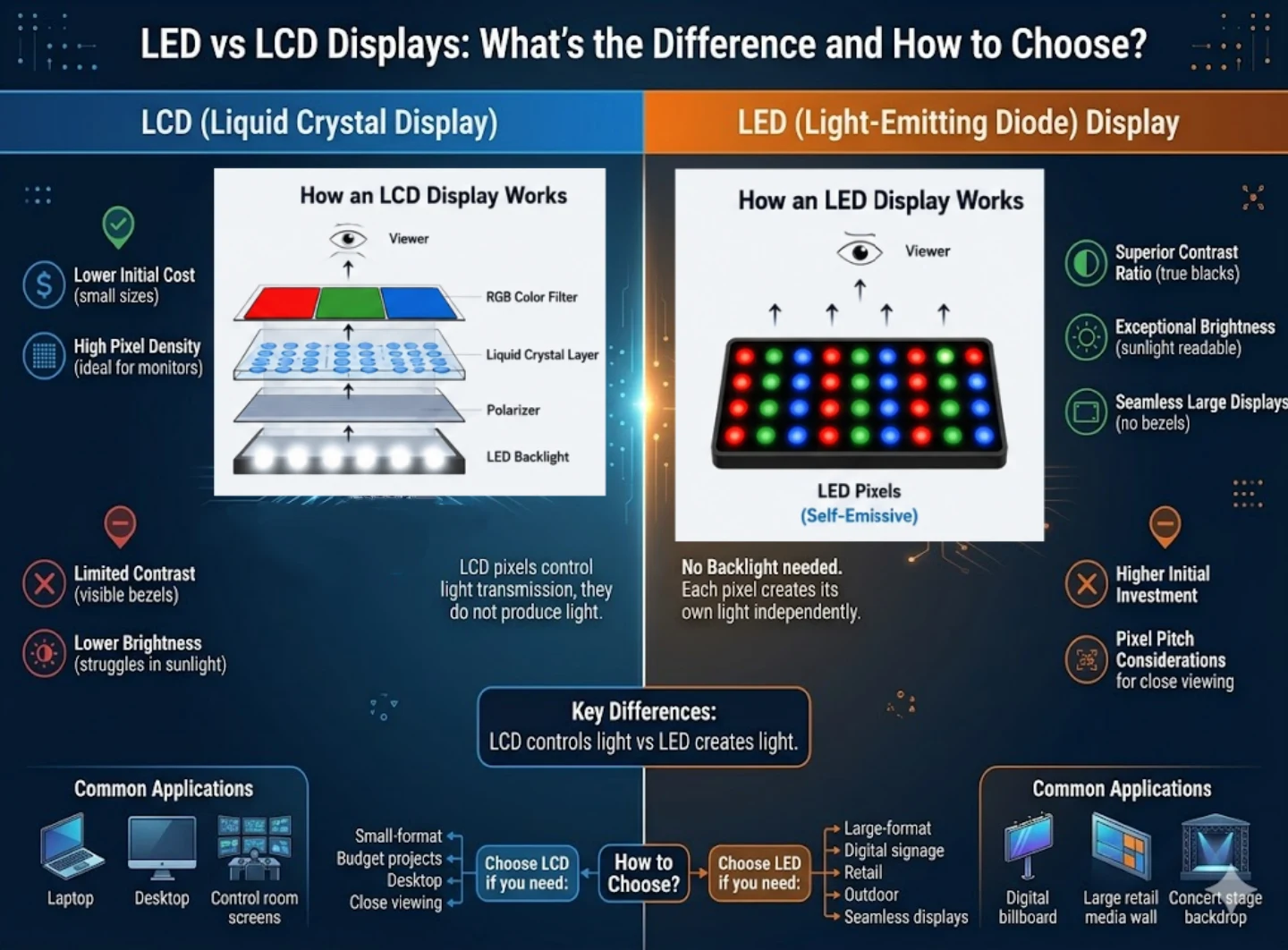
However, there is one crucial fact many people overlook: LCD pixels do not produce light. Instead, they control how much light passes through them. This is the foundation of the difference between LCD and LED displays.
How LCD Displays Create Images
Imagine the display process as painting a picture.
An LCD screen functions like a sophisticated system of light valves.
- The backlight acts as a constant light source.
- The liquid crystal layer acts as a controllable valve.
- Each pixel regulates how much light passes through.
- Color filters create red, green, and blue sub-pixels.
Every image you see is produced by controlling the amount of light transmitted through millions of tiny liquid crystal cells.
Brightness Control
Brightness is determined by the transparency of the liquid crystal molecules. The more light allowed to pass through, the brighter the pixel appears.
Color Control
Each pixel contains:
- Red sub-pixel
- Green sub-pixel
- Blue sub-pixel
By precisely controlling the light transmission of each sub-pixel, LCD displays can reproduce millions of colors.
In simple terms: The backlight is always generating light, while the liquid crystal layer controls how much light reaches your eyes.
What Is an LED Display?
Unlike LCD technology, an LED display is a self-emissive display technology. Each pixel generates its own light. There is no backlight and no liquid crystal layer. Think of an LED display as millions of microscopic light sources working together.
Each pixel independently determines:
- Whether it turns on or off
- How bright it becomes
- What color it displays
This direct-emission architecture is why LED displays deliver significantly higher contrast, brightness, and scalability.
LCD vs LED: Understanding the Fundamental Difference
The core distinction can be summarized in one sentence: LCD controls light, while LED creates light.
LCD:
- Light source behind the panel
- Pixels regulate transmitted light
- Indirect image generation
LED:
- Pixels emit light directly
- No backlight required
- Direct image generation
This seemingly simple difference leads to major performance differences.
LCD vs LED Display Comparison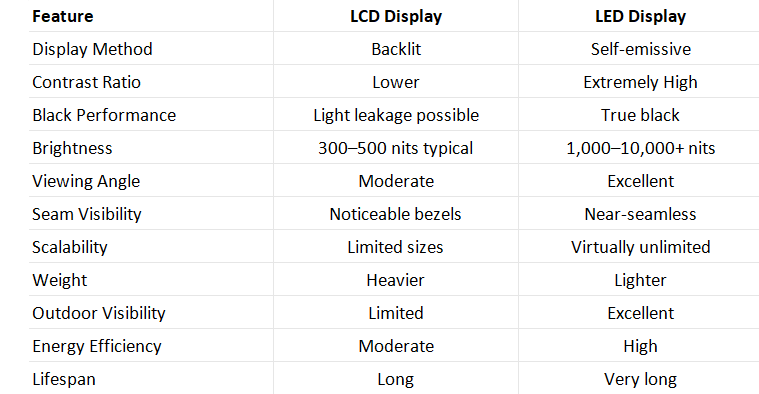
Advantages of LCD Displays
Despite the growing popularity of LED technology, LCD remains highly effective for many applications.
- Lower Initial Cost
LCD screens are generally more affordable for small and medium-sized display sizes.
- High Pixel Density
LCD panels can achieve extremely fine pixel density, making them ideal for: office monitors, laptop screens, control rooms, and desktop applications.
Limitations of LCD Displays
LCD technology also faces several inherent limitations.
- Limited Contrast
Since the backlight remains active behind the panel, completely blocking light is difficult. This can lead to: Grayish blacks, Halo effects, and Reduced image depth.
- Visible Bezels
Video walls built from LCD panels often contain visible borders between screens. These bezels interrupt image continuity and reduce immersion.
- Lower Brightness
Most LCD displays struggle in: Sunlit storefronts, Outdoor environments, and Bright exhibition halls.
- Size Constraints
Manufacturing limits restrict LCD panels to fixed dimensions.
Advantages of LED Displays
LED technology has become the dominant choice for commercial display applications because of several key advantages.
- Superior Contrast Ratio
Since individual pixels can turn completely off, LED displays achieve true black levels. This creates Greater depth, More vivid colors, and Higher perceived image quality.
- Exceptional Brightness
Commercial LED displays routinely exceed:
1,000 nits indoors
5,000–10,000 nits outdoors
This ensures visibility even in direct sunlight.
- Seamless Large Displays
LED modules can be assembled into displays of almost any size without visible bezels. This makes them ideal for Digital billboards, Retail media walls, Stage backdrops, and Corporate lobbies.
- Better Viewing Angles.
Modern LED displays maintain image quality even when viewed from extreme angles.
- Lightweight Design
Many modern LED systems use lightweight aluminum structures and thin-profile modules, reducing installation requirements.
Limitations of LED Displays
LED displays are not perfect for every scenario.
- Higher Initial Investment
For small screen sizes, LED displays generally cost more than LCD alternatives.
- Pixel Pitch Considerations
Viewing distance plays an important role. Very close viewing applications may require ultra-fine pixel pitch solutions to achieve the same pixel density as LCD screens.
- Installation Complexity
Large LED displays typically require professional design, installation, and calibration.
Transparent LED vs LCD: A New Category
One area where LED technology has created entirely new possibilities is transparency. Traditional LCD screens block visibility. Transparent LED displays allow viewers to see through the screen while displaying dynamic content. This makes them ideal for: Retail storefront windows, Shopping malls, Automotive showrooms, Museums, and Airport installations.
Transparent LED displays can achieve Higher brightness, Larger sizes, Better scalability, and Improved outdoor visibility. For businesses looking to combine digital advertising with architectural transparency, solutions such as InVisia LED Displays offer a compelling alternative to conventional LED systems.
Which Display Technology Should You Choose?
Choose LCD if you need:
- Desktop monitors
- Office displays
- Small-format screens
- Budget-sensitive projects
- Ultra-close viewing distances
Choose LED if you need:
- Large-format displays
- Digital signage
- Retail media networks
- Exhibition displays
- Outdoor advertising
- Architectural media
- Transparent display solutions
For modern commercial environments where brightness, scalability, and visual impact matter most, LED technology has become the preferred choice.
Final Thoughts
LCD and LED displays are not direct competitors as much as they are technologies optimized for different purposes.
- LCD excels at compact, high-resolution displays where cost efficiency is important.
- LED excels at creating large, bright, seamless visual experiences that attract attention and engage audiences.
As retail, advertising, and architectural display applications continue to evolve, advanced LED solutions—including transparent LED displays, holographic mesh LED systems—are increasingly becoming the standard for high-impact visual communication.
Explore the latest transparent display technologies at InVisia Displays and discover how next-generation LED solutions can transform storefronts, exhibitions, and commercial spaces.

 5th Floor, Building 9, Hengchangrong High-Tech Industrial Park, Bao'an District, Shenzhen 518128, China